Popular Post

Wednesday, April 13, 2011

1913 THOR 'BOARD TRACKER' UNEARTHED

Shot ca.1930, when the Thor was last given an airing
With dozens of 'original paint board-track racers' crowding the auction houses of late, parsing the clever fakes and the Real Deal has become an exercise in suspicion, head-scratching, and a desperate search for printed history which is thin on the ground.  Months ago, Virgil Eling, director of the Solvang Vintage Motorcycle Museum, sent a note to The Vintagent; is there any extant literature on Board Track Racing single-cylinder Thors?  My silence on the subject (proving no info at hand) led to a conversation with Virgil at the Las Vegas auction week, the premier spot in the US for a moto-schmooze.
The Thor as it appears today; grungy and original - perfect!
The results of Eling's research are in the metal, and the museum: a ca.1913 Thor board-track single-cylinder racer, untouched since 1930.  It lived its whole life with one family, near Chicago, the location of the Aurora Machine and Tool Co, who built Thor motorcycles and supplied components to seemingly the whole of the nascent American motorcycle industry.  The anecdotal history of this machine claims it was raced until 1920, laid up as we see it, then brought out by the family ca. 1930 for some dirt-track practice and new tires fitted, but time had marched on in such racing, and the clutchless, throttle-less Thor single proved a handful, and it was laid up again, as we see it today, a fascinating relic.  Research has yet to show another single-cylinder racing machine from Thor of this era, although there are photos of an earlier Thor, ca.1908 and identical to an Indian 'Torpedo Tank' racer (below).
ca.1909 Thor racer, of the type used by Don Johns to win races in California...
Like most early motorcycle makers, the Thor has roots in the bicycle industry of the late 1800s.  The Aurora Machine and Tool Co was founded in 1886 to supply component parts of bicycles; frame lugs, wheel hubs, spoke nipples, handlebars, etc.  One of their customers for bicycle-frame castings was George Hendee.  In 1901, Hendee, having formed the Indian Motocycle Co with Oscar Hedstrom, approached Aurora to build the first of their 'production' engines, as Indian had yet no forge or casting capability.  Hendee had already built 3 prototype motorcycles (cycle-pacers) with engines very similar to the ubiquitous DeDion design.  Aurora agreed to build the motors and supply component parts to Indian, with a 'non-compete' clause, stating they would not build their own motorcycles.
The first Thor v-twin from their 1908 catalog
The first Indian 'Moto-cycles' of 1902 used Aurora-built engines, 137 to be exact, and their archives note an 'unreliable and sporadic' supply of engines.  It is speculated that Indian themselves built the rest of their machine, although it is likely Aurora still provided chassis lug castings.  In a 'letter of the law' move, in 1903 Aurora formed the 'Thor Moto Cycle and Bicycle Co', which sold all of the parts necessary to build a motorcycle, in kit form.  While Thor per se did not sell assembled moto-cycles, a few other companies appeared in 1903 with Indian/Thor clones, although each was different, as Aurora sold no 'jigs' to build their frames, thus each was 'different enough' to avoid a lawsuit.
1911 Model 'O'
 The similarity between these different makes, all built with the same components, has resulted in much current-day confusion for restorers; is it a 1903 Indian, Thor, or something else?  The list of these early machines, built from Thor components, is long...according to Gregory Walter, they include "Thoro-bred, Reading Standard, Merkel, Apache, Racycle, Manson and in years later Sears and Torpedo."  Even Cyclone, Henderson, and Harley Davidson used Aurora parts.
From the 1913 catalog
 By 1908, the agreement with Indian having expired, Aurora began selling complete motorcycles at 'Thor', and established a dealer network.  That initial single-cylinder model, slightly updated, was joined by a v-twin with the engine distinctively canted forward, and atmospheric inlet valves, as with the single, and most other American machines at the time. Both models used Thor's own updraught carburetor.
1912 and later free-engine clutch with integral 2-speed gear cluster
1912 saw a redesigned range of singles and twins, with proper mechanically-operated valves, and the option of a two-speed bolt-on transmission  and clutch (above).  Schebler carburetors were now an option, as was a 1,200cc engine for the twin. By 1915, a new, cast-iron, bolt-on two-speed hub was available for Thor and other manufacturers (Henderson 4s used them), although this device was infernally heavy.
Ca.1912 Thor racer.
Regarding racing: from 1908-1912, Thor fielded a racing team, managed by William 'Bill' Ottaway, which had some notable successes after Ottaway - a gifted engineer - had tuned the engines, achieving results perhaps beyond any natural advantage of the Thor engine per se, as Thor seems not to have developed special racing engines as rivals Indian and Excelsior had done.  Ottaway's success was noted by the ambitious Harley Davidson management, who had never before supported racing, but saw the huge sales impact of race victories.  H-D lured Ottaway from Thor in 1913, and the incredible success of his racing team could be credited with raising H-D's profile from 'solid/dependable' to 'world beater' in just two years, with sales, as predicted, rapidly rising.  Thor, after losing the ace up their sleeve, offered in their 1915 catalog a 'Short Coupled' (shortened frame) racing machine to the public, and according to Gregory Walter, these were 1914 models 'tarted up' as racers, and not especially competitive.
Restored 1914 Thor twin
By 1916, more changes were afoot, and the last 'new' design meant a proper clutch and 3-speed gearbox, and a new single-cylinder design appeared in 1918.  Production must have been very slow during WW1, and the Aurora board of directors, finding profit in other manufacturing areas, agreed to cease motorcycle production in 1920.

Below are detail shots of our Board Track Single:

Original paint, original grease, original decal
Note the 'breathing' holes cut into the cylinder barrel; typical racing practice, albeit very messy!
The headstock showing the Aurora transfer; last patent listed is 1912 - from this we infer our machine is ca.1913, or slightly later.  Note original friction tape wrapping the controls.
Messinger 'Motorcycle Racer' saddle
The fine art of Edwardian pinstriping...
Schebler racing carburetor, with no throttle!  This Thor is ridden wide open, or stopped by the magneto cutout on the handlebar.


Many thanks to Gregory Walter's Thor Motorcycles website  and Dan Statnekov's amazing Pioneers of American Motorcycle Racing website for this information!

Tuesday, April 12, 2011

DUSTY MILLIONS

 Jaguar lightweight E-type racer...
The luxury of attending the launch party for this year's Tour Auto was a gift from Motul, as someone there understands motorcyclists need love too...and champagne.  Tour Auto is a 5-day 'race' across France, Paris to Biarritz, taken in stages with daily time totals, driven on back roads and proper race tracks when they lay on the rally route, and do they ever.  Day 1 incorporates the Montlhery circuit, although the road course, and 'not the banking'...every day incorporates a race track; Pau, LeMans,  Ville de Vienne, etc.  At the end of the week, time is calculated, winners are declared, and 300 rare and valuable race cars taken back to whence they came.  The theme for 2011 is 'Zagato', so there were plenty of Alfas, Maseratis, and Aston Martins with double-bubbles...
An odd trio, certainly!  Dino, Elan, Corvette
For the party, every sponsor had a tent at which to display their wares, while doling out obligatory canapés and bubbles.  If said sponsor was a bank, with nothing to display (besides the Money in copious abundance all around us), there were only platters of snacks and more champagne; these were the preferred watering holes.  Given the location of the party (the Jardin des Tuilieries, next to the Louvre, in Paris), and the sort of cars in this esteemed temporary parking lot, I guesstimate the fee for such a week's joy in the high five figures.  But the looking, for you and me, is absolutely free, so enjoy the photos, and b.y.o. champagne.
Brand new Norton Manx - keeping off dust in the Tuilieries is impossible..
I know you are a'feared this will be a 'car story', but two of the sponsors brought motorcycles to their tents; BMW and Norton.  BMW of Paris, who put on such a splendid show at the Paris Photo Expo this winter, had only modern two-wheelers on the floor, but the Paris Norton importer had a new Manx, which seemed apropos in the automotive company.
Ruby's Jérome Coste, master of moto-chic
With 8000 attendees milling about, it was a certainty to run into a few motorcyclists too, and Jérome Coste of Ruby Helmets was happy to have won his first 'cease and desist' case against a Ruby clone.  Jérome also mentioned immediate plans to release Ruby leather riding gear, and is hoping that next year some of the Tour Auto drivers will wear Ruby helmets for four-wheel racing.  A full-face design is in prototype now; can't wait to see it, and I'll do a feature on Ruby shortly...
Triple Webers, double cams, straight 6, Maser A6G Zagato
Of course, Renault Alpines!
Aston and Alfa, drool worthy
Perhaps the infamous Marie-Claude Beaumont LeMans 'Vette?
At least these Lancia Stratos' (Stratii?) looked at home in the dirt...
Plenty of Ferrari 250s; F, TDF, GTL, GTO
GTO; every letter worth a mil, or two...
Lancia Zagatos
Louvers near the Louvre; Healey 100M
The Maserati trident...
Two ultra-rare Jidé rally cars ca.1972
Just a few Porsches...
Even a Volkswagen!  And a Honda 600!

Saturday, April 9, 2011

TRENDS, CONTINUED...

As predicted in my January post from Las Vegas, big changes are afoot in the further integration of vintage motorcycles into the 'car world'...
Bonhams leads the pack in international motorcycle auctions, and combined motorcycle/auto auctions, as at their Grand Palais sale last February
Two days ago, automotive auction house RM Auctions announced the purchase of Bator Vintage Motorcycle Auctions, owned by Glenn Bator.  Bator shifted his vintage motorcycle brokerage company into 'auction mode' two years ago, after purchasing the J.Wood and Co, and conducting auctions at Daytona's Bike Week and at the Barber Vintage Festival.  RM will sell bikes under their subsidiary Auctions America, created two years ago to cater to American muscle cars and customs.
Shelby Myers of RM Auctions, at Las Vegas 2011
The expected move of RM into the motorcycle world (made quite clear by owner Rob Myers at Las Vegas) is a further reflection on both the increasing dollar volume of vintage motorcycle sales, and the increasing interest of automotive collectors in old bikes.  Tthe entry of RM into the 'old bike' auction fray will certainly mean new faces at dedicated motorcycle auctions, increased pressure on the price of the 'best' machines, and further integration of motorcycles into 'Car' events - both auctions and Concours d'Elegance.

In that vein, it has recently been announced that vintage motorcycles will appear at the ultra-prestigious Villa d'Este Concorso d'Eleganza for the first time ever, this May 20-22.  Surely the world's most elegant location for an automotive event, the Villa is situated on the shores of Lake Como in Italy.  Event sponsor BMW made the decision just two months ago to include motorcycles, and esteemed motorcycle author Stefan Knittel had the task of arranging the bikes for display.  Exactly how the motorcycles are physically integrated into the Concours will be very interesting...consigned to a side patch in the 'rough' as at Pebble Beach, or displayed, finally, with the automobiles?

Thursday, April 7, 2011

STEAM CYCLES AND HISTORY

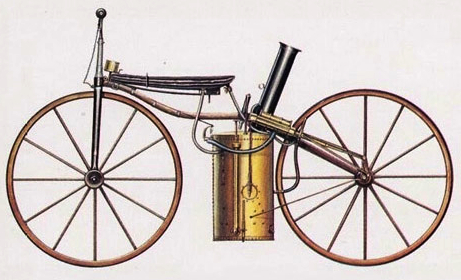
The Roper Steam Velocipede of ca.1867
While we think of History as immutable and as reliably solid as the configuration of hydrogen atoms, the 'truth' of our past is constantly shifting, as our individual or collective attitudes move from established belief sets to new paradigms, in which the interpretation of history, and indeed the very 'facts' of events, are seen in totally a new light, and our historic priorities are re-ordered [1].
Patent drawing for the Michaux-Perreaux Steam Velocipede of 1869
A paradigm shift in our view of motorcycle history is imminent, as alternatives to the internal combustion engine come to the forefront of technology, grow into general use, and are understood as the logical, even moral alternative to the vast political/economic/military structure hardened around the discovery, ownership, and distribution of fossil fuels.  History may well view our current troubles in oil-producing lands the economic equivalent of the Crusades, with oil the motivating 'religion'; it is inconceivable to oil-hungry nations that unfriendly hands control the source... regime change and war are thus justified.
The Mission One electric sports motorcycle.
As electric and alt-energy vehicles -including motorcycles-  come into general usage, the importance of their historic forbears is greatly magnified, and the first attempts at powered travel are seen in a new light.  Thus it is with the Steam Cycle.  Dismissed as a vestigal dead-end, nearly irrelevant to the history of Motorcycling, the very first powered two-wheelers in history have not been give their proper place in the family tree.  Indeed, my copy of the Oxford English Dictionary defines a Motorcycle as having 'an internal combustion engine' [2], which is simply ridiculous, given the great strides in electric motorcycling the past few years, and the TTXGP highlighting the viability of sporting battery power.
The Roper Steam Velocipede
Using a more generous definition of a Motorcycle, 'two wheels with a motor', the very first Motorcycles (then called Velocipedes) were built ca.1867-9.  Tied for this distinction are two steam-engine two-wheelers, one built in the USA by Sylvester Roper, the other in France by Louis-Guillame Perreaux and Pierre Michaux [3]. The two machines were both built around contemporary-pattern 'bone shaker' chassis, although each machine appears to have used a purpose-built frame between the wheels to adapt the engine.  The Michaux-Perreaux used a steel frame with the engine above the rear wheel, the Roper used a forged iron frame, with the engine suspended beneath.  Each machine deserves its own post, so I will oblige with more details later, after visiting the velocipedes in person (the M-P lives in the Musée de l'Isle de France, just outside of Paris, the Roper is in the Smithsonian).
The Michaux-Perreaux Steam Velocipede
These are the true forbears of every Motorcycle, and each is a remarkable testament not only to the ingenuity of their inventors (these small, portable steam engines were among the very first of their kind), but as well, the impulse, as yet unnamed, to ride a motorcycle.  They knew it was going to be good, and they were absolutely right.
The last development of the Roper Steam Velocipede, 1895
While the Michaux-Perreaux appears to be unique as a two-wheeler (they did, in 1884, build a 3-wheel version), Sylvester Roper went on to build another Steam Velocipedes, developing and refining the concept, perfecting his portable steam engine, making changes to his chassis. His last design of 1895 (above), was sponsored by the Pope Manufacturing Co., and used a modified Pope 'Columbia' safety-bicycle frame, the old 'bone-shaker' bicycle design having been modernized with steel tubes and rubber tires - and wheels of equal size were far 'safer' than the 'penny farthing' bicycle. This last Roper Steam Velocipede survives, remarkably, in private hands, about which more in my next post.
The Michaux-Perreaux at the Guggenheim's Art of the Motorcycle exhibit.
The Michaux-Perreaux appeared on the floor of the Guggenheim Museum for the seminal 'Art of the Motorcycle' exhibit, the first motorcycle confronting viewers as they entered, and to the show's 300,000 visitors, the charming little vehicle was complete news. Kudos to the curators for bringing this machine to light, to New York, and to the public consciousness as the First Motorcycle.  It's my understanding  the Roper was also meant to occupy the entrance, but the Smithsonian wanted a very substantial cash bond for the loan of what it rightly considers a priceless artifact of human history... thus the M-P stole the floor show, and now occupies a greater part of popular opinion as The First.  Such is the whim of chance, altering History...again.


[1]: For more on the subject, see Thomas Kuhn's 'The Structure of Scientific Revolutions'.
[2]: Even Cycle World's esteemed Kevin Cameron has argued that only the I-C engine counts as the true root of modern motorcycling, as "History follows things that succeed, not things that fail" (the statement itself a highly debatable claim on History!), while LJK Setright preferred to use the term 'heat engines', which includes steam, but excludes electric motoring.  Recent and online versions of the OED use 'two wheels and a motor, without pedals' - which excludes most motorcycles of the 1900s-20s, which HAD pedals!
[3]: There is much debate about exact dates on each of these machines; for this article, I call a tie, not having time to search the records for my own opinoin.  M-P patented his velocipede in 1869, but Roper's machine seems to have appeared in 1867, although Roper never patented his steam vehicle designs.

Sunday, April 3, 2011

CHANEL, DUCATI, REVISITED


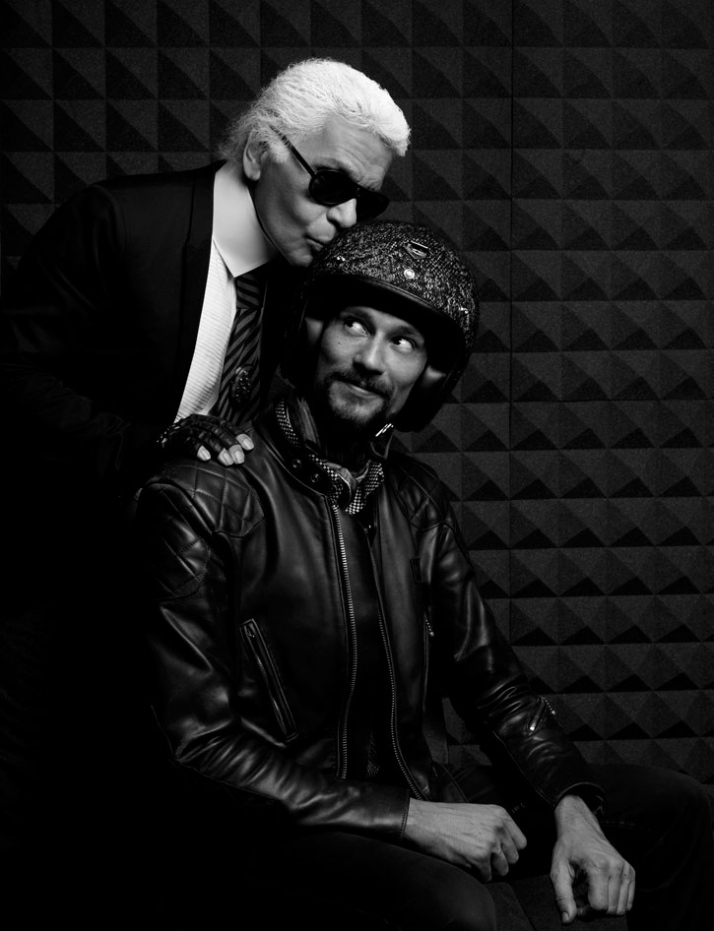
Uber-tastemaker Karl Lagerfeld fully understands the erotic power of old motorcycles, making them essential characters in his short films for Chanel (see the previous film here).  At the pinnacle of his long career as a fashion designer and photographer, Lagerfeld frequently uses motorcycle gear - boots, jackets, pants, helmets, and motorcycles themselves - as source material for his edgiest Chanel clothing.   His latest film, which I featured in production on a previous post, features a buff-colored 1970s Ducati 'square case' 750ss, and Keira Knightley.  While Ms.Knightley only rides the Duc while sitting on a trailer, her stunt double certainly looks good in a fawn suede jumpsuit, jumping the Ducati over stairs!

The entire color palette for Knightley's jumpsuit, boots, and the Ducati itself, was created to match an off-the-shelf Ruby 'Belvedere' helmet. Jérome Coste, Ruby's designer, has Karl's literal blessing (see below); revolving the art direction for this film around a non-Chanel product is quite a compliment.

For a bit more look at the Ducati, the Ruby, and Keira, here's a 'Making Of' video.  Interesting that Keira herself doesn't realize the erotic charge of seeing a woman in a catsuit riding a motorcycle, until she sees her stunt double riding the bike, when she is "almost embarrassed"!

Friday, April 1, 2011

NEW NAME, NEW HORIZONS!

Welcome to the new look of L'Vintagent!  Your favorite vintage motorcycle website is now under the protective wing of peerless luxury brand LVMH, owners of Louis Vuitton, Marc Jacobs, Zenith watches, Christian Dior perfume, Dom Perignon champagne... the finest things in life.
 LVMH has long held a profound interest in the Vintage car and motorcycle movement, sponsoring the Louis Vuitton Concours d'Elegance (above) for many years.  Those who appreciate the finest old vehicles understand that luxury is always the best value, and with the recent stratospheric rise in visibility of top-tier motorcycles, and the enthusiastic arrival of automotive collectors to the world of two-wheeled excellence, L'Vintagent is already the gold standard.
Our new editor needs no introduction; Mr. Pitt is an enthusiastic collector of Vintage and Custom machinery, and will delight readers with unique reflections on his motorcycling, career, and family life. And what a family!  Watch for his intimate portrait of his wife, currently filming 'Tail of the Devil', the incredible life story of Marie Therese von Hammerstein, in which Ms. Jolie executes her own stunts on a cleverly disguised 1961 Triumph TR6.  "If Bud Ekins can do it, so can I," says the plucky Angelina! 
Mr. d'Orléans will continue to draw a devoted following with his 'I'll go anywhere' attitude, and 'I'll ride anything' reportage.  His premier article for L'Vintagent is the first road test of the latest LVMH project: a resurrection of the visionary Sinclair C5, completely updated and with a tremendously powerful new engine, which will change every concept of a 'commuter vehicle', forever!